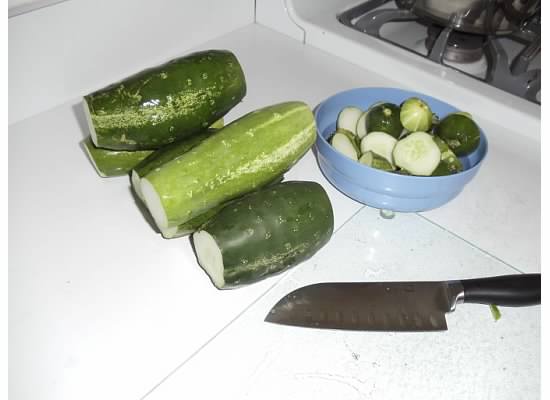
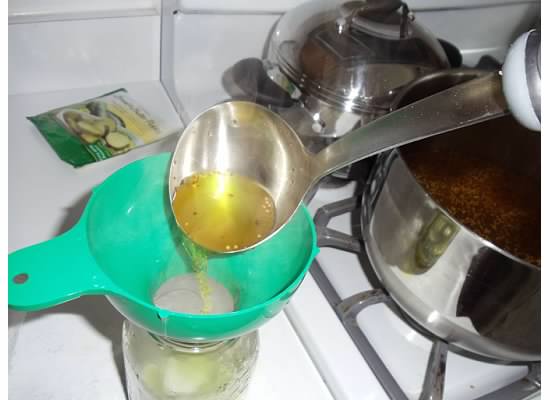
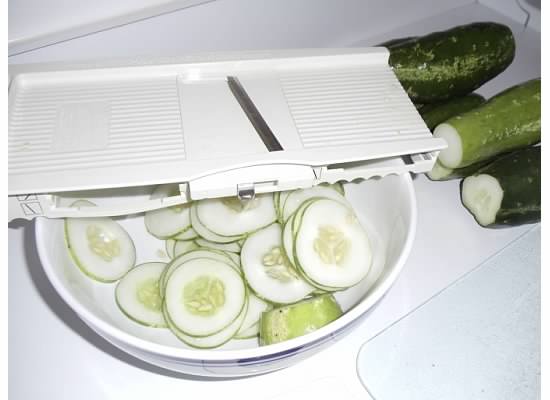
I would have really liked to slice them with a "crinkle cut", but I did not have that attachment, so I settled for plain old flat.
| Watch the video below to learn more about Mike`s Seeds of the Month Club: |
| Watch the video below to learn more about Mike`s Seeds of the Month Club: |
| Tweet |
Last year was by far the best year for cucumbers that I have ever had. With a good mix of care and of course, excellent weather, the cucumbers I started from seed, blossomed and produced unlike any season before. Here is what I did last year. Hopefully you will have great success as I did.| Watch the video below to learn more about Mike`s Seeds of the Month Club: |
| Tweet |
If you had room to plant only three vegetables, what would they be and why? I was recently asked this question by a friend. Before I get into what I would grow let me address why I would grow the ones I did choose. If I only had space for three vegetables I would make sure I first grow something that has a high yield and second, make sure I am growing something that I and my family would enjoy eating.| Watch the video below to learn more about Mike`s Seeds of the Month Club: |
| Tweet |
I love to start all of my fruits, vegetables and herbs from seeds, and although I do very well, I can sit here and honestly say that all of my efforts are not successful. In fact, this past season my cantaloupe did not fair as well as I had hoped, but my eggplant on the other hand were the best crop I have had in my life. That’s just the nature of vegetable gardening. Just when you think you have one crop mastered, you have a bad season with it. Maybe that is par for the course.| Watch the video below to learn more about Mike`s Seeds of the Month Club: |
Our goal here at Mike the Gardener Enterprises is to get vegetable gardening in every yard everywhere we can think of!
It isn’t as if most people have old tractor tires just lying around collecting dust. Nevertheless, a good old tire that’s no good for driving on anymore doesn’t have to go to the trash pile. And when it comes to raised beds, there’s hardly a thing better than a burly tractor tire. By making a few minor alterations, removing the upper rim and painting the outside, that old hunk of rubber can have a second life—maybe even one that is nobler than the first.
Cucumbers are a great vegetable to grow in any garden. They are excellent for salads, or to simply dip in some ranch dressing (or your favorite flavor).
Cucumbers are a great vegetable to grow. They are easy to maintain and yield a high amount of fruit.When they get to the correct size most people will just pick the cucumber by yanking on it and ripping it off the vine.If you use that technique you could be doing more damage to your cucumber plant then you know.Here is how you can properly pick a cucumber.http://www.ehow.com/how_5238959_pick-cucumbers-right-way.html
Seven years ago I moved into my new home in the suburbs. I lived in a city where the sight of a rabbit was as a rare as Halley’s Comet. In fact in the city in which I lived, pigeons were more of a problem than any other type of animal you could think of.

Vermicompost, also known as worm castings, is the end result of worms feeding off of organic material such as food waste. Vermicompost has shown in studies that it contains much needed water soluble nutrients your vegetables, fruits and flowers crave.
You can either make your own vermicompost by adding worms and food scraps to a ventilated container or buy vermicompost commercially. Either way is fine and if just adding nutrients to your soil is not enough proof to use vermicompost than read these three other ways to justify its purpose.
Soil
I have mentioned this already and that is vermicompost adds much needed nutrients back to the soil. Each growing season your plants will use certain nutrients in order to flourish. If you do not replenish those nutrients, your plants will eventually stop growing or die. Also, vermicompost enriches your soil with various micro-organisms by adding enzymes such as phosphate and cellulase. Vermicompost also more deep burrowing earth worms already in the soil and will actually increase your soil’s water holding capacity.
Plants
Your plants love vermicompost obviously for the nutrients it provides but also for the fact that vermicompost has been shown to enhance germination and increase crop yields. Recent studies have even shown an improvement in root growth and structure of various plants.
Economic
Since you are using your food waste to create vermicompost, it goes without saying that you when you do this you are adding less garbage to local landfills. And because you are not simply throwing the food away, it reduces the amount of biowaste which in turn reduces potential contamination in our streams and waterways. Also in some parts of the country, in large scale production centers for vermicompost, jobs have been created. Somebody has to do the work right? Vermicomposting is a low cost way to create natural fertilizer, thereby making it possible to add much needed nutrients to the soils of a lot of less developed agricultural regions.
Large scale productions of vermicompost have been shown in some studies to have a higher yield of valuable soil microbial probably because of the feedstock waste available. This does not mean that your homemade vermicompost is not adequate enough for your gardens though.
You should definitely start implementing a process in creating your own vermicompost so that you can add it to your soil so your plants can start enjoying all the benefits mentioned above and more. If you want to learn more about the vermicomposting process there are a number of good books on the market and you can visit the Cooperative Extension Service website which is a division of the United States Department of Agriculture. The COE is an informal educational program that exists only within the United States that was designed for the sole purpose of helping people with research based knowledge.
Vermicomposting is a must for any gardener that wants to improve their plants and the soil that their plants grow in. If you are a gardener or an aspiring one, and you are not creating your own vermicompost, then you should be. Start your vermicompost bin today.
document.write(getResources());
About the Author
Bruce is the co-author of the book Vegetable Gardening for the Average Person. It is a practical easy to follow book that teaches gardeners everything from composting techniques, aeration and frost conditions, to choosing the right tools and picking the right seeds. To learn more about Mr. Tucker you can visit: AveragePersonGardening.com.

Vermicompost is the end result of organic material such as food waste after it has been digested by some species of earth worm. Commonly referred to as worm castings, vermicompost contains water soluble nutrients and bacteria that make a great organic fertilizer for your garden.
The process in which you feed a worm organic material and turn it into vermicompost has an actual name called vermicomposting.
Although every worm produces worm castings, the worm best for the job to produce quality vermicompost for your garden’s soil is called Eisenia foetida or the red wiggler earthworm. Most of North America will use this species of worm, but if you live in a tropical part of the world, look towards Perionyx excavatus (Blue worms) and if you have a more acidic soil then use Eisenia hortensis (night crawlers).
Vermicompost can be used to brew compost tea, a rich elixir that is sprayed on the plant’s leaves and stem as well as added to the soil so the roots of your vegetables can absorb the tea’s nutrients, and vermicompost can be mixed directly in with your soil.
You can buy vermicompost at many nurseries or garden centers, but you can actually make your own with a box, some worms, and a little water and some time.
The easiest way to make your own is to buy a large plastic or rubber container (similar to one you would store household items in), drill holes in the lid, and the sides for air ventilation, and drill holes in the bottom for water drainage. Then put down two inches of shredded newspaper, followed by shredded leaves, grass clippings (in limited quantities) and your food left scraps followed by another two inches of shredded newspaper.
To get some worms just look on your sidewalks or in the street after a heavy rainfall. They will be crawling everywhere. Their homes get flooded and they go to higher ground where it is wet but more tolerable.
You simply put the worms on top of your shredded newspaper and put the lid on. The worms will work their way down through the newspaper and find the food waste. It is very important that you keep the contents of your bin moist. Worms need a moist environment in order to thrive. A simple misting of the contents of the bin on a daily basis should suffice. As a side note, place something underneath the bin to catch any water drainage. Any moisture you capture you should then be dumped back into the bin.
You will know when it is time to retrieve and harvest your vermicompost by simply seeing that very little or no food scraps remain. There are a couple of ways to harvest the vermicompost. The first way is to dump the entire contents out, and remove the worms by hand. The second way is to divide your rubber container in half initially by only placing food scraps on one side of the container. Then when it is time to harvest the vermicompost you add food scraps to the other side. When you do this the worms will move to the side where there is food leaving you with a near wormless side of quality vermicompost.
Vermicompost is a great way to add much needed nutrients to your garden’s soil and the best part is you can do make it right in your own backyard all year round.
About the Author
Bruce is the co-author of the book "Vegetable Gardening for the Average Person: A guide to vegetable gardening for the rest of us". It is a practical easy to follow book that teaches gardeners everything from composting techniques, aeration and frost conditions, to choosing the right tools and picking the right seeds. To learn more about Mr. Tucker or to inquire about the book you can visit: http://www.averagepersongardening.com/.