Showing posts with label grown. Show all posts

Friday, August 10, 2012

Turn Your Home Grown Cucumbers into Pickles

Have you ever grown your own cucumbers?  If so, then your next step of progression is to turn all of those wonderfully juicy cucumbers into great tasting pickles.  If you have never grown cucumbers, then this blog post should get you excited to do so, as you will see just how easy it is to turn those home grown cucumbers into great tasting bread & butter pickles.

I will say this.  I don't care what recipe you follow to make pickles, if you do not start with good fruits or veggies, your end product won't matter.  Canning will not make it taste better, only preserve the great taste it has to begin with.
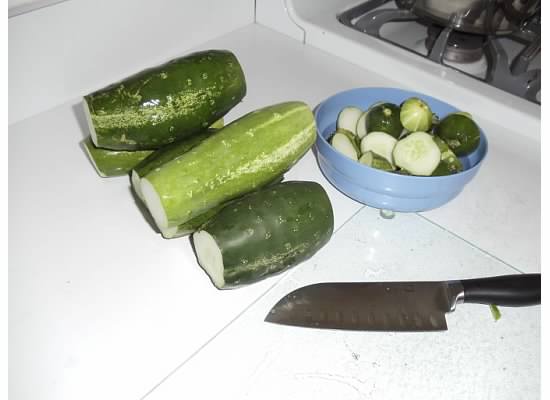
So for this exercise, let's start with some home grown cucumbers.  This year I grew Ashley cucumbers.  They yield plenty to work with and taste great.  Not the most ideal variety for pickling purposes, but adequate none the less.  If you want a great tasting, true pickling cucumber, go with the Boston variety.

Once you have your cucumbers, slice off the ends as it makes it easier to have a flat surface of the cucumber to work with when using a mandolin slicer.  If you don't have a slicer, not to worry, simply use a sharp knife. 

I would have really liked to slice them with a "crinkle cut", but I did not have that attachment, so I settled for plain old flat.
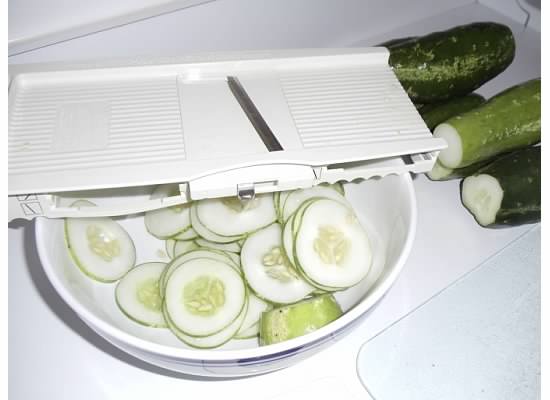
The slicer I use has a nice feature where it "grips" the bowl that the slices go into.  This made it much easier to slice the cucumbers much faster.

I talked to a few people and they have electric slicers which work fast and well.  Probably a good idea to get one in the future if you plan on pickling loads of cucumbers as my friend does.

However, a simple mandolin slicer will do the trick.

I did not use a homemade recipe as I went the very easy route and used a pre-made mix.  For my pickles I chose Mrs. Wages Bread & Butter Pickles mix.  The recipe for this mix is as easy as it gets. 

You mix the dry ingredients in the pack with sugar and vinegar and then heat it up over the stove so everything will blend together.  Very simple!


Now go ahead and fill your jars.  Do not fill all the way to the top as you need to leave some room for head space.  

I filled mine up to just about where the jar starts forming into the mouth.

I also used my canning funnel to make sure none of the residue of the pickles touched the tops of the jar.  While not catastrophic if it does, it makes cleaning easier.
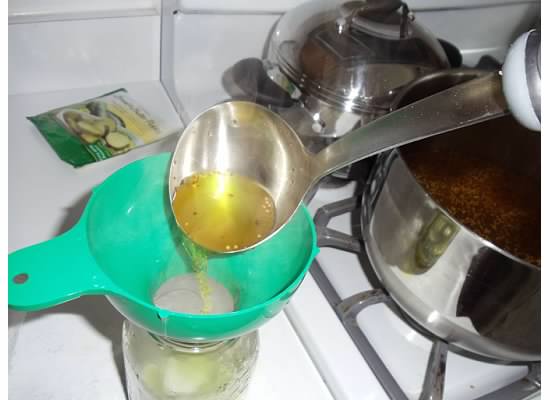
Now that your jars are filled with cucumbers, using a ladle, start pouring the hot pickling mixture into your jars.  Definitely use your funnel for this step.  

Fill the jars with the liquid leaving about a 1/4" of head space.  That is a 1/4" of space from the top of the jar where the lid will sit.

Once the jar is filled, make sure you remove as much air from between the cucumbers as possible by sliding a butter knife (or some other non sharp object) down inside the jar, moving the cucumbers off the side.

You can use the hot water bath method for this process.  I explain the hot water bath method, here, for tomatoes.  The process is the same.

The back of the mix packet will tell you exactly how long to heat this up for, which will be 35 to 45 minutes, depending on where you live as your locations altitude makes a difference.

And that's it!  Great tasting bread & butter pickles, made from cucumbers, right out of your garden.  Once you make these, and see how easy it is to do, you will never want to buy pickles from the store again.

About the Author 
Mike Podlesny is the author of Vegetable Gardening for the Average Person: A Guide to Vegetable Gardening for the rest of us, the moderator for the largest vegetable gardening page on Facebook and creator of the monthly Seeds Club.

Watch the video below to learn more about Mike`s Seeds of the Month Club:

Tuesday, November 22, 2011

5 Home Grown Vegetables for Thanksgiving


The holiday season is upon us which for our family kicks off with Thanksgiving. Thanksgiving is that one day out of the year where we recognize how lucky we are to have our health, family and friends around our dinner table and of course the gratefulness that even in these tough economic times we can still put a nice meal on the table to enjoy the day.

One thing I am personally thankful for is for the day my dad taught me how to vegetable garden, how you can grow your own food and that it is easier then you think. It is a skill that I can pass along to my two sons and hopefully they pass along to their children one day.

Being able to grow our own food not only puts healthy, fresh fruits, vegetables and herbs on our table but we are able to donate a lot of food to local food pantries and needy families, so my family is very thankful that we can do that as well.

What I wanted to do is give you a list of the fresh items that I will be serving on my Thanksgiving table this year.

Green Beans
A fellow vegetable gardening member on our Facebook page recently sent me a message about the green beans he grew this past season. To make sure he grew enough he had ten Kentucky Wonder pole bean plants growing up on a home made trellis. Of course if you know anything about pole beans in general you immediately say to yourself, “Good Lord, 10!” That is because they produce and produce and produce and keep going. They make the energizer bunny look inferior once they start growing. He even said, “my neighbors stopped answering their doors because they didn’t want anymore.” That is how many ten plants will yield. Beyond that, for my family, the Thanksgiving dinner table would be incomplete without the green bean casserole. With home grown green beans the casserole tastes so much better (at least it does to me).

Celery
I will be the first to admit that celery is not the easiest item to grow. The seeds are so tiny that they are nearly impossible to work with. Most of the time when I start my celery seeds I end up planting a lot per each starter cup, which I then I have to trim back. However, once you are able to get the celery going, fresh celery mixed in with the stuffing is fantastic. Also, I have inherited a family recipe from my mom called stuffed celery. Not sure if she got it from somewhere or made it up herself, but it’s nothing more than cream cheese mixed with chopped up gerkin pickles and green olives. Take that mix and fill the celery. Something about the crunch of the celery with that mix is such a great taste.

Salad Greens
This is my generalized category for all items such as lettuce and spinach that would be included in my salad. I will be literally having the freshest salad come Thanksgiving day. That is because greens such as lettuce and spinach will grow well into the cooler months of November and with a well built cold frame you can easily get fresh greens all winter long. Imagine being able to pick your Thanksgiving day salad 10 to 20 minutes before you serve it.

Pumpkin Pie
Ok we aren’t actually growing pumpkin pies here, but we can grow the main ingredient in a pumpkin pie recipe and that is the pulp to be used. Everyone has their favorite pumpkin and/or squash they grow for this purpose and I am no different. I like the Blue Hubbard Squash. The pulp inside, once cooked and pureed, makes for a nice sweet addition to any pumpkin pie recipe. Sugar Pie Pumpkin is another good one as well.

Potatoes
What would be Thanksgiving day dinner without the different varieties of potatoes that will be served. From sweet to my wife’s garlic mashed red recipe, home grown potatoes are an excellent way of bringing what you grow at home to your dinner table. I would not consider potatoes a difficult crop to grow in my area, and they can be left in the ground until you plan on harvesting them for consumption (in many cases).

I can list a lot of other items that I have served in the past as well as I am sure you and your family have your favorites as well. Enjoy your home grown Thanksgiving!

About the Author
Mike Podlesny is the author of Vegetable Gardening for the Average Person: A Guide to Vegetable Gardening for the rest of us, the moderator for the largest vegetable gardening page on Facebook and creator of the Seeds Club.

Watch the video below to learn more about Mike`s Seeds of the Month Club: