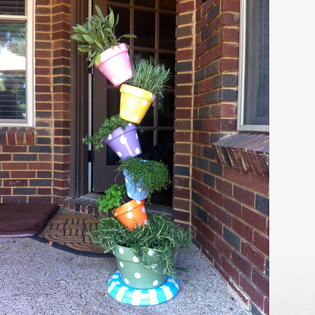
If you have been following our blog, facebook page, or our website, then you already know that we are very enthusiastic about growing vertically.
The sky is truly the limit when it comes to growing vertically with many
varieties of fruits and vegetables, and herbs are no different.
Herbs grow great in containers, and this project combines the best of
both worlds, container gardening and vertical gardening. If you have
some basic tools and handy skills, then all you really need is to get
started.
Here are the Step by Step instructions
Showing posts with label vertical. Show all posts
Tuesday, June 4, 2013
Tuesday, May 21, 2013
DIY - Folding Trellis for your Vegetable Garden
Using a trellis in your home
vegetable garden has a wide range of benefits. For starters it allows
you take advantage of vertical real estate you may not have though of.
You save a lot of space when growing vertically and a trellis allows you
to do just that.
Second, some items grow great on a trellis and I could not imagine growing them any other way, such as cucumbers.
Here is an excellent trellis that you can build with some basic materials, a little time and folds up for better storage in the offseason.
Here are the Step by Step instructions
Second, some items grow great on a trellis and I could not imagine growing them any other way, such as cucumbers.
Here is an excellent trellis that you can build with some basic materials, a little time and folds up for better storage in the offseason.
Here are the Step by Step instructions
Tuesday, August 21, 2012
Grow Watermelons in your Garden, Vertically!
While I would be the first to admit that growing watermelons vertically isn't the best method, for many of us, when you lack space, you have to do what is best to get the results you are looking for.
There is nothing wrong with growing watermelons vertically, you will just need to do a couple of extra steps to ensure that the watermelon has something to grow up and of course can be propped up.
Let's start with what you can use as a vertical support system. If you have grown cucumbers, beans, or peas then you already have the experience needed for vertical watermelons. You will simply use a trellis.
A trellis made from some wood or netting will work, but keep in mind the watermelon vines and the watermelon itself will get fairly heavy, so try to use something that can easily withstand their weight. As you can see in the photo above I am using a lattice trellis made from pine wood and then stained with a water based outdoor stain. This gives me the strength I need to support the vines, and of course the watermelon.
Be sure to join Mike`s vegetable seeds mailing list
This brings me to the support portion. How do you support such a heavy fruit? Well, there are a number of ways that I have seen it done, but the one that works best for me is a simple shelf.
I took two pieces of old pine wood that I had in my garage and made an "L" shaped shelf. One part of the shelf will attach to the trellis itself, I will get to more on that in a moment, and the other part will support the watermelon.
I took this step to the extreme and attached the two pieces of wood to make the shelving unit, using dove tail joinery. If you have been following my blog you also know by now that I love woodworking as well. This type of joint is very strong, and gets just some glue to keep the two pieces of wood together.
You can use outdoor deck screws to attach the pieces as well, as that will hold also. I try not to use nails as they are not as strong as screws or the dovetail joints....at least in my opinion.
I attached the shelving unit to the trellis using nothing more than two deck screws, long enough to go through the shelf and of course the trellis. Try not to go all the way through the trellis as you will have the pointed end of the screw sticking out which could scrape you later.
And that's it! You can stain the shelf itself if you would like it to withstand the weather for a few seasons. Pine does not wear well in the outdoors. I did not preserve this particular shelf, but might sand it down and give it a couple coats of water based stain in the gardening off season. We'll see. I included another photo below of larger watermelons sitting on another shelf for support, attached to the same trellis.
About the Author
Mike Podlesny is the author of Vegetable Gardening for the Average Person: A Guide to Vegetable Gardening for the rest of us, the moderator for the largest vegetable gardening page on Facebook and creator of the monthly Seeds Club.
| Watch the video below to learn more about Mike`s Seeds of the Month Club: |
Location:
Burlington Township, NJ, USA
Monday, December 12, 2011
Podcast Episode #90: Vertical Gardening
| Tweet |
Short on space? Try vertical gardening. Listen in as Mike talks about some creative ways to maximize your limited area. For information on vertical gardening, be sure to visit http://www.averagepersongardening.com
Mike Podlesny is the author of Vegetable Gardening for the Average Person: A Guide to Vegetable Gardening for the rest of us, the moderator for the largest vegetable gardening page on Facebook and creator of the Seeds Club.
| Watch the video below to learn more about Mike`s Seeds of the Month Club: |
Tuesday, October 4, 2011
Short on Space? Try Growing Up
| Tweet |
I am a very fortunate person when it comes to my vegetable gardening space. I have plenty to grow what I know my family will consume leaving plenty left over for friends, family and donations to our church and local food pantry. However, many people have emailed me with their concerns of limited space.They would like to grow vining plants such as cantaloupes, cucumbers and pole beans, but lack the space they need to simply let them “fan” out if you will. If you find yourself in this category, you are luck. You can grow these items, and many more like them, vertically.
With vertical home vegetable gardening, the sky really is the limit. All you need to do is create a structure of sorts to give your plants something to hold on to. For heavier items, such as cantaloupes, you will also need to be a bit creative as to have something to hold up the fruit.
In his book Vertical Gardening: Grow up, Not Out, for More Vegetables and Flowers in Much Less Space, Derek Fell, shows you how to creatively use a Trellis, tower of pots and garden netting, for what he says allows you to enjoy the, “benefits of easier maintenance, healthier plants, and higher yields.”
An obvious solution for use of space that many people overlook is the back or front porch steps. Depending on which gets the most sun, porch steps make for a great area to use deep pots to grow many items, taking advantage of space that is otherwise not used.
Along with the plentiful yields of great tasting fruit, veggies and herbs, vertical gardening makes garden maintenance much easier as all of the vines are off the ground, yielding a clear path to those pesky weeds that want to steal your plants valuable soil nutrients.
Vertically gardening, as well as use of space, is only limited by your creative thinking. I have seen many gardeners use their existing fences for supports, pergolas, the roof tops of sheds, fire escapes (although I don’t think the fire department appreciates that one) and so much more. What empty space do you see in your area that could otherwise be used to grow great fruits and veggies?
On a final note, herbs are a great to grow on indoor window sills. Just make sure you pick a window that receives sunlight first thing in the morning.
About the Author
Mike Podlesny is the owner of Mike the Gardener Enterprises, LLC, the exclusive home for the Seeds of the Month Club, which has appeared on NBC, ABC and MSN Money as a great way for consumers to save money.
| Watch the video below to learn more about the Seeds of the Month Club: |
Friday, July 10, 2009
How to Grow a Vegetable Garden with Limited Space
Even if you are limited on space you have an opportunity to grow your own vegetables and fruit at home. Listed in this tutorial are a few ways you can make the most out of what space you do have.
Use pots. Many people do not think twice about putting flowers in pots, but many of those same people think it odd to grow watermelons or zucchini out of one. As long as the pot is over ...
http://www.ehow.com/how_5168822_grow-vegetable-garden-limited-space.html
Use pots. Many people do not think twice about putting flowers in pots, but many of those same people think it odd to grow watermelons or zucchini out of one. As long as the pot is over ...
http://www.ehow.com/how_5168822_grow-vegetable-garden-limited-space.html
Tuesday, June 30, 2009
Home Vegetable Gardening: Five Tips To Help You Grown Better Fruits
Walking in your Garden
With every step you take in your garden you compress the soil underneath and that prohibits air flow as well as water drainage. If you can not or do not have the ability to create a raised bed gardening system, then here is a solution to distribute your weight evenly when you need to walk through your garden. You can lay down a piece of plywood over the areas where you are going to walk. When you step on the piece of wood, your weight gets more evenly distributed. You can also designate certain parts of your garden to be considered “walk” areas. La down some mulch will help reduce the impact on underlying layers of soil.
Fertilizer Numbers
Although I would rather see you enrich your soil via means of composting and vermicomposting many must use commercial fertilizers. If you are one of those people you should know what the numbers mean on the packaging. You will see the N-P-K ration listed on packages of fertilizer. N-P-K stands for nitrogen, phosphorous and potassium. So if you see a fertilizer that reads 15-5-5 it means that it contains a ratio of 15 parts nitrogen to 5 parts phosphorous to 5 parts potassium.
Going Organic
Home vegetable gardeners more so then any commercial industry will have an easier time going organic. Because home vegetable gardens are smaller and more manageable it becomes more realistic to use organic methods. For instance, a home vegetable gardener won’t have to use power tools to cultivate the soil. A pitchfork or shovel will suffice. Home vegetable gardeners can bury food waste directly in their backyard or set up a vermicompost bin to create quality humus that will add much needed nutrients to your soil.
Vegetable Offspring
A very popular question that we receive on our website is, “is it possible to grow vegetables from the seeds of vegetables grown in a backyard vegetable garden?” In short the answer is yes. But there is more to it that will affect the quality of the taste. If you grew the vegetable plant from a hybrid seed, which means it is a cross between more than one variety of plant, the offspring of that plant won’t be as tasty as the original and may even look a bit different. If the seed wasn’t a hybrid then the offspring should be identical and that will lead to the same taste.
Space Limited
If your space is limited you have a few options you can use to make the most out of the space that you do have. For instance you can grow vegetables out of pots. Just make sure the pot has a depth of at least 8 inches and a 6 inch diameter. You can set up a raised bed gardening system, enclosed by a wooden frame, bricks or any number of other material. Again make sure the depth is at least 8 inches. Try growing vertical. Cucumbers, pole beans, and melons are a few varieties of plants that you can direct where they go because they are vines. You can save a tremendous amount of space by using a trellis and having them grow vertically.
About the Author
Mike is the author of the book Vegetable Gardening for the Average Person: A guide to vegetable gardening for the rest of us. He can be reached at his wesbite: AveragePersonGardening.com where you can sign up for his free newsletter and he will send you a pack of vegetable seeds to get your home vegetable garden started.
With every step you take in your garden you compress the soil underneath and that prohibits air flow as well as water drainage. If you can not or do not have the ability to create a raised bed gardening system, then here is a solution to distribute your weight evenly when you need to walk through your garden. You can lay down a piece of plywood over the areas where you are going to walk. When you step on the piece of wood, your weight gets more evenly distributed. You can also designate certain parts of your garden to be considered “walk” areas. La down some mulch will help reduce the impact on underlying layers of soil.
Fertilizer Numbers
Although I would rather see you enrich your soil via means of composting and vermicomposting many must use commercial fertilizers. If you are one of those people you should know what the numbers mean on the packaging. You will see the N-P-K ration listed on packages of fertilizer. N-P-K stands for nitrogen, phosphorous and potassium. So if you see a fertilizer that reads 15-5-5 it means that it contains a ratio of 15 parts nitrogen to 5 parts phosphorous to 5 parts potassium.
Going Organic
Home vegetable gardeners more so then any commercial industry will have an easier time going organic. Because home vegetable gardens are smaller and more manageable it becomes more realistic to use organic methods. For instance, a home vegetable gardener won’t have to use power tools to cultivate the soil. A pitchfork or shovel will suffice. Home vegetable gardeners can bury food waste directly in their backyard or set up a vermicompost bin to create quality humus that will add much needed nutrients to your soil.
Vegetable Offspring
A very popular question that we receive on our website is, “is it possible to grow vegetables from the seeds of vegetables grown in a backyard vegetable garden?” In short the answer is yes. But there is more to it that will affect the quality of the taste. If you grew the vegetable plant from a hybrid seed, which means it is a cross between more than one variety of plant, the offspring of that plant won’t be as tasty as the original and may even look a bit different. If the seed wasn’t a hybrid then the offspring should be identical and that will lead to the same taste.
Space Limited
If your space is limited you have a few options you can use to make the most out of the space that you do have. For instance you can grow vegetables out of pots. Just make sure the pot has a depth of at least 8 inches and a 6 inch diameter. You can set up a raised bed gardening system, enclosed by a wooden frame, bricks or any number of other material. Again make sure the depth is at least 8 inches. Try growing vertical. Cucumbers, pole beans, and melons are a few varieties of plants that you can direct where they go because they are vines. You can save a tremendous amount of space by using a trellis and having them grow vertically.
About the Author
Mike is the author of the book Vegetable Gardening for the Average Person: A guide to vegetable gardening for the rest of us. He can be reached at his wesbite: AveragePersonGardening.com where you can sign up for his free newsletter and he will send you a pack of vegetable seeds to get your home vegetable garden started.
Subscribe to:
Posts (Atom)