Showing posts with label nutrients. Show all posts

Tuesday, October 25, 2011

5 Power Vegetables to Grow in Your Garden


Vegetable gardening is a great activity. It gets you outdoors and is really one of the only hobbies that you can literally eat the fruits of your labor. Today, there is an emphasis on eating healthier, especially for our children, unlike anything I have seen in the past 20 years or so. I recently posted an article on our blog titled, Home Vegetable Gardening: The New Prescription from Doctors and Nutritionists where I discussed the increasing trend of how health professionals are making home vegetable gardening the new prescription.

I wanted to follow up that article with a list of vegetables that gardeners, looking to maximize their space, can grow to ensure they are eating the veggies that yield the highest amounts of vitamins, minerals and nutrients your body needs for a healthier you. I call them, the power vegetables.

I turned to nutrition expert Todd Cambio, BA, BS, CSCS, Sports Nutritionist who is also the author of the book Reducing Pain and Everyday Inflammation: How to Feel Better, Have More Energy, and Increase Flexibility. Todd specializes in sports recovery methods and nutritional counseling. “I highly recommend pretty much all veggies as long as you are mixing up the colors regularly and eating them raw as much as possible,” says Todd. “Eat veggies at every meal, at least one cup.”

The top five power veggies Todd recommends are Broccoli, Butternut Squash, Spinach, Onions and Red Bell Peppers. “I recommend these veggies because they supply you with numerous antioxidants, fiber, electrolytes and anti-inflammatory properties,” says Todd. “Also these red, yellow and orange colored veggies contain carotenoids. Carotenoids are powerful antioxidants, protecting the cells of the body from damage caused by free radicals. Carotenoids are also believed to enhance the function of the immune system.”

All 5 are easy to add to any home vegetable garden, although butternut squash will take up the most room, so you will want to grow them vertically if space is an issue, which you can read more about in Derek Fell’s book Vertical Gardening: Grow Up, Not Out, for more Vegetables and Flowers in Less Space.

Broccoli, spinach and onions are cooler weather crops, where as the red bell peppers love the heat, so plan accordingly. If you are looking for alternatives for any of these as maybe you may not like the taste or flavor, Todd says you can substitute cauliflower, cabbage & zucchini for broccoli; acorn squash and carrots for butternut squash; arugula and other dark leafy greens for spinach; other members of the onion family such as shallots for onions; and other varieties (either sweet or hot) for red bell peppers.

With your own home vegetable garden you have the ability to grow the foods your body needs to be healthier, and as we all know, and as studies have shown, home grown foods, taste better and are higher in nutrients than their store bought counterparts.

About the Author
Mike Podlesny is the author of Vegetable Gardening for the Average Person: A Guide to Vegetable Gardening for the rest of us and the administrator for the largest vegetable gardening page on Facebook.

Watch the video below to learn more about the Seeds of the Month Club:

Sunday, May 31, 2009

Vermicomposting Tips for your Vegetable Garden

Vermicompost is the end result of organic matter being consumed by earth worms. Also commonly known as worm castings, vermicompost adds much needed nutrients to the soil that have been depleted with continuous growing seasons.

Every variety of worm creates worm castings; obviously. However the most common worm to be used in this process throughout the United States and Europe is called the red wiggler earth worm, the Eisenia foetida. It has been found that these worms produce the best vermicompost as compared to other worms and are the species of worm that should be used.

There are two great ways to create vermicompost and add it to your soil. One way takes a little more effort than another, but both can be implemented with great success.

For my own vermicompost, I like to use food scraps left over from meals. The red worms love this stuff and the end result of castings have done wonders for my own vegetable garden.

The first way and the easiest way to add vermicompost to your soil is to bury your food scraps in your garden. Get your self a Tupperware bowl (with lid) and as you have left over’s from your meals, coffee grinds from your morning coffee etc., add them to your Tupperware bowl. When your Tupperware bowl is full take it to your garden where you will dig a hole about one and a half to two feet deep and dump the contents of the Tupperware bowl into the hole. Cover the contents with dirt and you are done. The earth worms are already in the ground and they will find the food scraps that you buried.

Mark the spot with a stick so the next time you go to bury food scraps you aren’t digging in the same location. Then you simply repeat this process through the year. When it comes time to put you plants in the ground, mix your soil by turning it over with a pitchfork or garden tiller and you will mix in all the vermicompost that was created.

But what happens when the ground is frozen or the plants are in the ground, you surely can’t bury it then right? Yes that is correct, but that brings me to my second method and that is the use of a compost bin. A compost bin can be any type of container where you will add in some worms and put your food scraps in. Let me explain.

You can either build a compost bin or buy a generic Rubbermaid plastic storage container. Drill holes in the bottom for drainage, the sides and top for ventilation and you will have yourself a compost bin. Now add two inches of shredded newspaper to the bottom of your bin, then your food scraps, then another two inches of shredded newspaper, then finally your worms. You can get worms by digging in your garden or looking on your sidewalks and streets after a big rain storm. A couple dozen will do as your worm population will double about every 30 days.

Check the bin every few days and when there is very little food scraps left it is time to extract the vermicompost from the bin and start the process over. You can separate the worms from the compost manually by hand, but why do that when you can have them do it themselves. Instead of using the entire bin all at once to create vermicompost, only use half of the bin. When the half you are using is low on food scraps, start using the other half. The worms will move to the side where there is food, thus separating themselves from the vermicompost.

You might have a few stragglers left, but that’s ok, you can leave them in there and put them in your garden as well. Your worm population, like I mentioned earlier, will double in size every 30 days, so it is good practice to remove some of the worms every time you extract your vermicompost.

See how easy that is. If you start using both of these methods today, your soil could be full of all the nutrients that your vegetable garden will ever need, and you can stop buying those chemical fertilizers which offer no value to your soil.

About the Author
Mike is the author of the book Vegetable Gardening for the Average Person. It is a practical easy to follow book that teaches gardeners everything from composting techniques, aeration and frost conditions, to choosing the right tools and picking the right seeds.

Tuesday, May 26, 2009

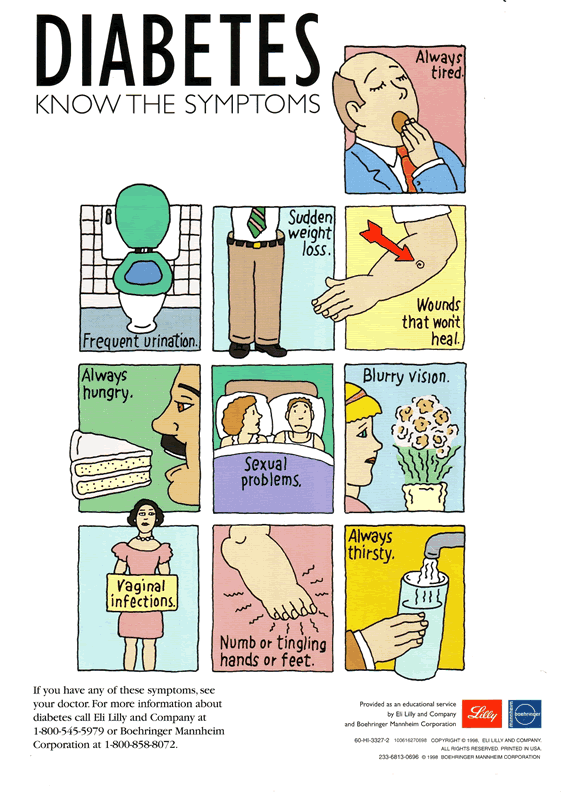
Diabetes: Growing Your Own Fight


A large portion of the population has in some way or another one of the two types of Diabetes. This article won’t go into medical detail as to each of the types, but it will go into the affects that fresh vegetables can have in fighting diabetes.

Fresh vegetables are such a positive factor in fighting diabetes, and because they are, you are also presented with a great opportunity to grow your own cure (so to speak).

Certain vegetables can be consumed in large quantities because they are low in calories and low in carbohydrates. Buying fresh vegetables at the grocery store can start to add up and get very costly. You can offset that cost by growing your own vegetables.

These vegetables are an excellent course for diabetics because of their low caloric count and all can be grown right in your backyard:

Cabbage, celery, lettuce, spinach, eggplant, cauliflower, cucumber, radish

These make up just a few of the many you can grow and eat in larger quantities. Of course you should always speak to your primary care physician as to which vegetables offer your condition the better benefits and then you can grow them to help with any costs you might incur at the grocery store.

For instance, a spinach plant can produce good tasting healthy spinach throughout an entire growing season in most parts of the country. The average cost for a bag of fresh spinach is around $2.99. That one bag would last you about a week. If you grew your own spinach, three plants could give you enough of a harvest for half of the year, saving you money, and allowing you to eat more of it.


The same holds true for any vegetable and as the studies have shown us, eating healthy fresh vegetables helps in the fight against diabetes.

Just remember to eat them fresh when you can, such as in a salad, or uncooked. The nest best thing would be, baked, broiled or steamed. You could also grill your vegetables and get a good flavor. Also fresh is always better than frozen, so try to ingest the fresh vegetables not too long after you pick them.

With the cost for transportation always increasing due to high oil prices that will lead to higher costs for store bought vegetables. Save that cost and walk out your back door and pick the vegetables you need to help fight diabetes. They are better than store bought vegetables anyway since you are the one growing them the way that you want. You know that no harmful chemicals are being sprayed. You know that you have taken the utmost care for them because you will invariably be the one eating them.

Take the steps necessary to start growing your own vegetable garden today. It will help save you money at the store and fresh vegetables will help in your fight against diabetes.

About the Author
Mike is the author of the book Vegetable Gardening for the Average Person. It is a practical easy to follow book that teaches gardeners everything from composting techniques, aeration and frost conditions, to choosing the right tools and picking the right seeds.