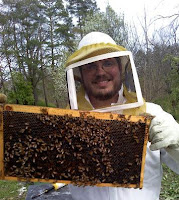
A few months ago I was watching an episode of
House Hunters on HGTV. Ok, my wife was watching it, but I was in the room. In any event, one of the three houses the couple were looking into purchasing was situated next door to a neighbor that had beehives, of the neighbor’s own doing, in their backyard. I was thinking to myself, `who in their right mind would move in next to a house with bees?!?`. To my shock, that is the house the couple chose and in exchange for the couple’s “allowance” of the neighbor to have bees, the neighbor gave them honey anytime they asked for it.
Don’t get me wrong I don’t dislike bees. As a home vegetable gardener I completely understand their tremendous importance in the pollination process. It just seemed odd to me to raise bees in my backyard.
So instead of writing off the idea of raising bees as some notion of environmental craziness, I researched the topic further to find out the answers to the who,what,where,when and why’s. What I found out through various articles, magazines and newscasts (you can see loads of videos on YouTube), bee keeping is extremely popular.
Aaron Warner, a high school science teacher has been bee keeping for 8 years. Aaron recommends before you even get started, to read at least 3 books, preferably recently written within the last 10 years, on the topic. This will give you a tremendous amount of information to make informed decisions.
“Start with two hives if possible purchasing nucs of bees rather than packages of bees,” says Aaron, and ”Be prepared to receive conflicting information when you ask beekeepers how to ..... It's not rocket science. Most mistakes are small and very fixable.” I will explain what a “nuc” is in a moment.
It sounds fairly simple, but what are the three best tips a seasoned bee keeper can give you if you want to get into the hobbby? I turned to Patrick Freivald, the vice president of the Ontario-Finger Lakes Beekeeping Association (
ontariocountybeekeepers.org) and a large hobbyist beekeeper with a roadside stand in Canadice, New York. Here are three tips that Patrick recommends to follow.
Find a groupBeekeeping organizations can be found all over the world, and interest in beekeeping is very high. While asking three bee keepers a question will often as not garner four conflicting answers, nothing beats the helping hand of an interested and dedicated mentor. Mentorship, beekeeping classes, and deals on bees and equipment are just a few of the benefits of joining a local group, and membership is almost always free. From mites to bears to nervous neighbors to marketing honey, your local group of bee keepers will have answers to all of your questions, concerns, and problems.
ReadJust as Aaron suggested, there are fantastic books out there,
Kim Flottum's Backyard Beekeeper,
Ross Conrad's Natural Beekeeping, and
Beekeeping for Dummies by
Howland Blackiston are just three of the dozens of excellent guides for the aspiring apiarist (a person who studies or keeps bees). If you can find them, anything by the late Richard Taylor is excellent.
Bee Culture Magazine and the
American Bee Journal are both excellent sources of information for beekeepers, whether for new hobbyists or long-time commercial bee keepers.
EquipmentBuy only new equipment from reputable companies such as
Mann Lake,
Dadant,
Brushy Mountain, or
Bee Commerce. Old equipment can harbor diseases such as
American Foulbrood, which is devastating to any bees in the area, can remain dormant and undetected for decades on old equipment. Foulbrood can spread quickly and most states require foulbrood-infected bees and equipment to be burned -- disheartening and expensive for the new bee keeper, and not likely to win friends amongst his beekeeping neighbors. Be safe; buy new.
So what can you expect from a bee harvest and how quick is the production time? According Patrick, “Beekeepers should not expect a honey harvest their first year, because the bees will spend much of their effort building comb (though that doesn't mean they won't get one! Two new bee keepers I am mentoring this year got over 60 lbs of honey on each of their brand new colonies, though this kind of first-year performance is quite rare.) After the comb is drawn, the honey harvest varies depending on location, weather, and the particulars of each colony of bees. My personal experience has ranged from no extra honey, as a lot must be left behind for the bees to survive the winter months, to over 100 lbs of surplus from a single colony. My average for the past few years has been around 35 lbs of honey per colony per year in rural Western New York State.”
With all of this bee keeping information in hand you are ready to get started right? Well not so fast, Patrick recommends you take a class on bee keeping as most fees charged for taking the class will also include a “nuc”, short for nucleus colony of bees. Expect to pay about $100 for the course (and bees) but be prepared for the additional costs that most newbies don’t think about which include, woodware, a suit and veil, smoker, and a hive tool, although they are one time costs (or at least should be).
About the AuthorMike Podlesny is the owner of
Mike the Gardener Enterprises, LLC, the exclusive home for the
Seeds of the Month Club, which has appeared on NBC, ABC and MSN Money as a great way for consumers to save money.


 In this week's episode, Mike talks with Carol Niec and Kerrie Rosenthal about the Seed Keeper Project.
 The Seed Keeper Project
is our opportunity to recognize school gardens across the country.
Each year we award a Seed Keeper Home Farmer and a Certificate to a
school in every state and the District of Columbia highlighting their
dedication to gardening.
The Seed Keeper Project
is our opportunity to recognize school gardens across the country.
Each year we award a Seed Keeper Home Farmer and a Certificate to a
school in every state and the District of Columbia highlighting their
dedication to gardening.


