Thursday, April 3, 2014

Which Grow Light Bulbs are You Using?

http://www.amazon.com/gp/product/B0001XLSGQ/ref=as_li_qf_sp_asin_il_tl?ie=UTF8&camp=1789&creative=9325&creativeASIN=B0001XLSGQ&linkCode=as2&tag=indocquent-20
A lot of vegetable gardeners out there start their vegetable seeds indoors to get a jump start on the gardening season. 

Most of the time starting vegetable seeds indoors is a necessity due to a shortened vegetable garden season and other times it is because winter was a bit rough and you are anxious to get gardening season going.

Whatever your reason is (as if you really needed any reason at all), starting vegetable seeds indoors is always a good practice, but can be very challenging, as noted by this question from fellow vegetable gardener, Brandon Williams.

I started vegetable seeds yesterday, and plan to get a light to hang above them. I've heard that a standard 4 foot shop light would look fine. What kind of bulbs would be most beneficial?
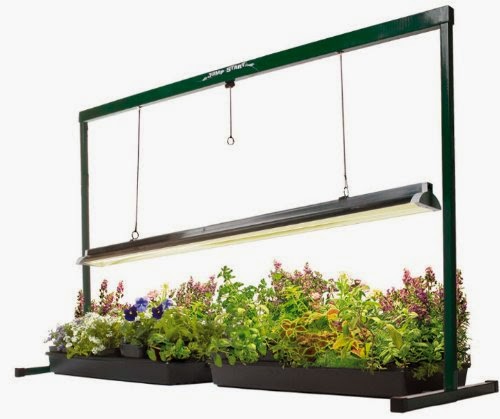
The challenge for many will be two main factors, space and light.  While I can't really do anything for your space issues (although there are some cool things you can try that we'll talk about in a future article), you can solve your lighting issue, by using grow lights.
Which grow lights you use for your vegetable seeds will make the world of a difference.  You should take into consideration some key points of your lighting before you go shopping.
Your vegetable seeds are going to want bright light.  I am sure you have heard of the term "leggy" before.  What that means is that your vegetable plants (after the vegetable seeds have germinated) are not getting enough light, so your vegetable plants are "stretching" towards to closest light source.  This will produce a stem on your vegetable plants that are long and weak.
Choose a light that is very intense,yet does not produce a lot of heat.  Fluorescent bulbs  are perfect for this application.  Always keep your grow lights three inches above your vegetable plants.  Far enough away for safety reasons, but close enough so your vegetable plants can utilize the light without having to "stretch" for it.
Just remember to raise your fluorescent lights as your vegetable plants grow.  Keep a three inch height above your vegetable plants at all times.
So how long do you keep your grow lights on?  While you may be thinking "if vegetable plants need light, and 8 hours is considered a full day's worth, why not simply keep the grow light on for a full 24/7?".  Because, just like you and me, vegetable plants need rest as well, and that is accomplished when it is dark.  
What you can do is put your fluorescent grow lights on a timer.  Keep your grow lights on for 14 to 16 hours and then turn them off for 8 to 10 hours.
Now for the nuts and bolts of Brandon's question.  "What kind of bulbs would be most beneficial?".  Available at any home and garden center, as well as at pet stores that sell aquarium related supplies, look for Full Spectrum Light Bulbs.
Full-spectrum light is light that covers the electromagnetic spectrum from infrared to near-ultraviolet, or all wavelengths that are useful to plant life.
They can vary in price based on size and manufacturer so shop around to get the one that is priced right for you and your vegetable gardening application.
http://www.averagepersongardening.com/seedsclub
 

Saturday, March 29, 2014

#175: Mike talks with Gary Oppenheimer of AmpleHarvest.org

Follow now on your RSS feed Listen now on your mobile device Download from iTunes


AmpleHarvest.orgIn this week's episode, Mike talks with Gary Oppenheimer, the Executive Director and Founder of
Ampleharvest.org, a self described aging geek, he has worked with computers and communications going back to the 1970's.

As director of a community garden in 2009, he learned about the wasted food in many plots and created a program called "Ample Harvest" to get the excess food to local food pantries.

Realizing this as a nationwide problem, he created a nationwide solution called
Ampleharvest.org to use the Internet to educate, encourage and enable millions of growers nationwide to share their ample harvest with local food pantries in all 50 states.

In this episode, here’s what we’ll cover:

  • All About Gary Oppenheimer
  • All about AmpleHarvest.org
  • Just in time inventory
  • Gary Oppenheimer as a CNN Hero
  • Obstacles that AmpleHarvest.org faced in the early going
  • Food Pantry Restrictions
  • The goals and vision of AmpleHarvest.org
  • Your food donation as a tax deduction
  • AmpleHarvest.org's mission
  • Eye opening statistics on the amount of food waste in America
  • How to donate to your local food pantry
  • What you should be donating
  • How to find a food pantry close to you
  • How to get your local food pantry on board
  • Bill Emerson Good Samaritan Act of 1996

Items mentioned in this episode include:

About this week's Guest, Gary Oppenheimer of Ampleharvest.org:

While more than 50 million Americans live in food insecure homes (including a quarter of all children under the age of six), more than 40 million Americans grow fruit, vegetables herbs and nuts in home gardens - often more than they can use, preserve or give to friends.

Struggling to feed their families, many Americans, both those chronically economically challenged as well as those now impacted by the economic downturn have come to rely on the more than 33,500 food pantries (also called food shelves, food closets, food cupboards or food banks in some areas) across America to help feed their families.

These food pantries, relying on donated and purchased foods, almost never have fresh produce and instead rely on canned or processed produce shipped from across the country at significant cost, both economic and environmental.

At the same time, millions of home and community gardeners nationwide with an abundant harvest do not know that they can share their harvest, do not know how to share their harvest and do not know where to share their harvest.
Ampleharvest.org solves that for them.

Ampleharvest.org envisions an America where millions of gardeners eliminate malnutrition and hunger in their own community.

Ampleharvest.org, moving information instead of food to diminish hunger and malnutrition in America, is educating, encouraging and empowering growers to share their excess harvest with the needy in their community instead of letting it rot in the garden.

Our "No Food Left Behind" goal is a healthier and by extension, wealthier America.

Previous Podcast Episodes

Thursday, March 27, 2014

Getting the Garden Ready for Cold Weather Vegetables Like Broccoli and Brussels Sprouts

The other day I received this question from Brenda, a fellow vegetable gardener:
So here in Ohio we have had a wickedly cold winter. Today it is still just 27 degrees. When should I think about getting my garden ready for cold weather plants like broccoli and brussels sprouts?
You should be tending to your soil throughout the year anytime it can be worked.  Adding in compost, vermicompost, organic material and so on.
When trying to figure out when you should start your garden, and I am focusing here on starting seeds indoors, there are two ways that you can figure this out.
The first way is to obtain your growing zone, for those of us that live in the U.S.A., visit the plant hardiness interactive zone map at http://planthardiness.ars.usda.gov/PHZMWeb/
Here is the picture of what the zone map looks like.  It has changed in recent recent years, adding more detail. 

I don't have Brenda's zip code, but I do have her state, in this case Ohio.  Ohio has three growing zones associated with it, 5b, 6a and 6b, as shown below.
Now that we know what the zones are, you can match them up on the
First and Last Frost Dates, by Hardiness Zone

That is the first way, however a better way to calculate when your area will be ready for gardening is to visit the NOAA Climatic Data Center and click on your state in the box on the lower left side of the screen.

In this case Brenda would select "Ohio".  After doing so, a new window will open with a PDF labled "Freeze/Frost Occurrence Data" for the state of Ohio.  This PDF will list all of the climate data you have ever wanted, and a lot of data that you never knew existed.

Once you know when the last frost will be in your area, and when frost will hit you again in the fall/winter, planning your garden becomes much easier.  You will know how long your gardening season is.

Once you know the length of your gardening season, you can calculate when to start your seeds indoors.  On the back of your seed packet it will tell you "Days to Maturity" or DOM.  Knowing this will tell you when you should start your seeds indoors so can get a jump start on your seeds to make sure you have enough time to reap a harvest.

http://www.averagepersongardening.com/seedsclub

Saturday, March 22, 2014

#174: Mike talks with Vincent Suozzi Creator of the Ring Weeder

Follow now on your RSS feed Listen now on your mobile device Download from iTunes


The Ring WeederIn this week's episode, Mike talks with Vincent Suozzi, a middle school teacher from Long Island, turned inventor of a really cool and useful weeding tool.

From the word "go", you will hear Vincent's passion and enthusiasm, as he takes you on his journey from his product being just an idea, up through his widely successful Kickstarter campaign.

His garden tool, called the Ring Weeder, was chosen as Yahoo! Home's top 10 kickstarter campaigns for new garden products. Since that time he has been interviewed for local and national news outlets, as it seems everyone wants to know more about Vincent and the Ring Weeder.

In this episode, here’s what we’ll cover:

  • All about Vincent
  • The history of the Ring Weeder
  • Vincent's gardening passions
  • The Ring Weeder chosen by Yahoo! home
  • How the ring weeder works and what is its best applications
  • The Ring Weeder's Successful Kickstarter Campaign

Items mentioned in this episode include:

About this week's Guest, Vincent Suozzi of the Ring Weeder:

Hi I'm Vinnie and I currently work at Westbury Union Free School District in Westbury Long Island. I teach 6,7 and 8th grade Physical Education and Health.

I also have been in the Landscaping business for over 30 years. I specialize in flower design and rose care.

I'm married to my wife Anna for 30 years and have 2 sons, John 26 (graduate of Drexel University in Philadelphia) and Stephen 23 (graduate of The George Washington University in DC).

I love teaching and I love designing flower gardens. I have the best of both worlds. I’m always thinking of new and creative "out of the box" activities for my students. I also apply this creativity when it comes to gardening. This is how I came up with the Ring Weeder. If Edward Scissors hands can do it, why cant I?

Thursday, March 20, 2014

Should gardening be taught in schools?

This is the question I was pondering to myself the other day.  As someone who loves vegetable gardening, the answer for me would be easy ... an astounding absolutely!  But what about someone who may not be into vegetable gardening at all, or only "dabbles" in it?  Why would anyone just dabble in vegetable gardening? We'll save that question for another time :)

However, I think it is a great debate question.  Let's face it, food is "kind of" important and if we can teach our youth where it comes from, how to grow their own, I believe it will go a long way for a more sustainable future.

And if gardening is taught in schools, should it be a mandatory class or an elective?

I would like to get your thoughts on this?  Comment below and let me know.